Karpathy: RAG Is Dead. We Built the Living Wiki Alternative.
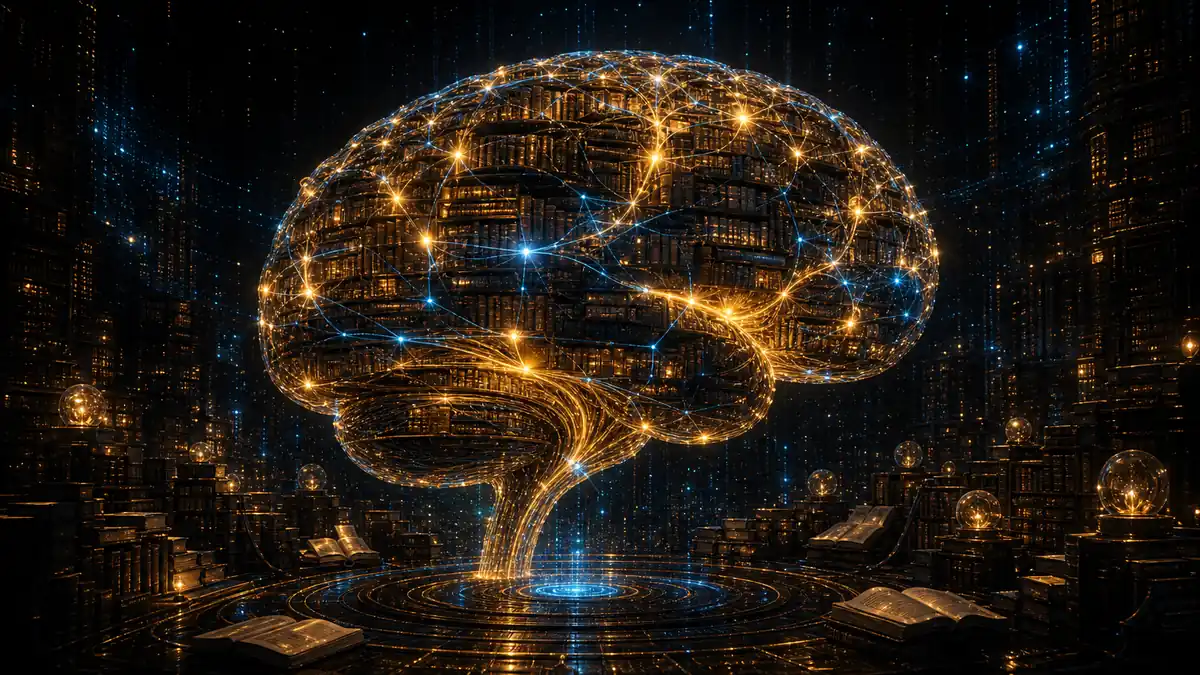
Karpathy just said what we've been doing for weeks.
See the live leaderboard: Claude vs GPT vs Grok — Live AI Trading Arena. Real-time PnL, updated every 30 minutes. No backtest, no cherry-picking.
On April 3, 2026, Andrej Karpathy updated his approach to AI knowledge management. His take: RAG (Retrieval Augmented Generation) is fundamentally flawed because it "rediscovers everything from scratch on every query." No accumulation. No learning. Just brute-force search every time.
His alternative: a Living Wiki — Markdown files that AI maintains, compiles, and improves over time. No vector database. No embeddings. Just structured .md files that grow smarter with every interaction.
VentureBeat covered it. TechBuddies analyzed it. DAIR.AI discussed it. Everyone's talking about it.
We've been running this in production since March 2026.
What Karpathy proposes
His pattern is beautifully simple:
- Raw data → unstructured information comes in (logs, results, observations)
- Compilation → AI reads the raw data and compiles it into structured Markdown
- Wiki → the compiled knowledge lives as
.mdfiles that anyone (human or AI) can read - Health checks → automated validation ensures the wiki stays accurate and up-to-date
The AI acts as a "librarian" — it doesn't just retrieve information, it organizes, structures, and maintains it. Over time, the wiki becomes a living knowledge base that accumulates intelligence instead of rediscovering it.
No vector DB. No embeddings. No chunking. No retrieval pipeline. Just files.
What we built (before he said it)
Strategy Arena's Living Wiki has been running this exact pattern since March 2026:
Raw → Compilation → Wiki → Health Checks
| Karpathy's Pattern | Strategy Arena's Implementation |
|---|---|
| Raw data | data/autoresearch/*.json — nightly results from 8 engines |
| Compilation | wiki_compiler.py — runs at 5:30 AM, reads all raw files |
| Wiki | data/wiki/*.md — 7 compiled Markdown files |
| Health checks | Strategy Health Check — 7 frameworks, A+ to F |
Every night, our 8 autonomous engines run 3,500+ experiments:
- Darwin Engine mutates strategy parameters → results saved as raw JSON
- Chimera evolves pattern detection → raw JSON
- Leviathan optimizes voting weights → raw JSON
- Invictus refines crash protection → raw JSON
- Hydra trains ML models → raw JSON
- Meta-Harness optimizes Darwin itself → raw JSON
At 5:30 AM, the Wiki Compiler reads all raw results and compiles them into structured Markdown:
- Which entry types win most often (lesson: "RSI sweet spot = 25")
- Which patterns failed (lesson: "avoid pure MACD in sideways markets")
- Winning vs losing parameter ranges
- Cross-engine correlations
The next night, when Darwin runs again, it reads the wiki first before generating mutations. It doesn't rediscover from scratch — it builds on accumulated knowledge.
Why RAG falls short (and what we did about it)
Classic RAG works like this: 1. User asks a question 2. System embeds the question into a vector 3. System searches a vector database for similar chunks 4. System feeds those chunks to the LLM 5. LLM generates an answer
The problem Karpathy identifies: every query starts from zero. The system has no memory between queries. It doesn't learn that "RSI 25 works better than RSI 30" after being asked about it 50 times. It just re-searches every time.
What we built instead: the Arena Brain uses graph-augmented retrieval (inspired by LightRAG):
- Question comes in
- Keywords are extracted locally (no LLM needed — $0)
- The Knowledge Graph (121 nodes, 134 connections) finds relevant systems
- Neighbor expansion: connected systems are included (1-hop graph traversal)
- Only relevant data is fetched — not a blind vector search
- The Living Wiki's accumulated lessons are included in context
- Claude Haiku generates an answer with targeted, pre-compiled knowledge
The key difference: step 6. The wiki has already compiled and structured the knowledge. The Arena Brain doesn't rediscover — it retrieves pre-compiled intelligence.
The decay + consolidation layer
We went further than Karpathy's base pattern. Inspired by elfmem (an adaptive memory system), our Living Wiki has:
- Decay: old lessons lose strength over time (5% per day). A lesson from 2 weeks ago that hasn't been confirmed is weaker than yesterday's discovery.
- Consolidation: lessons confirmed by multiple engines get stronger. If both Darwin and Chimera agree that "RSI 25 works," the lesson's strength increases.
- Pruning: very weak lessons are automatically removed. The wiki stays lean and relevant.
This happens every night as part of the Meta-Harness run — the agent that optimizes Darwin Engine's own hyperparameters.
The numbers
| Metric | Value |
|---|---|
| Total experiments (all-time) | 2,500+ |
| Wiki lessons accumulated | Growing nightly |
| Nightly engines | 8 (including Meta-Harness) |
| Knowledge Graph nodes | 121 |
| Knowledge Graph connections | 134 |
| Raw data files | 7+ JSON files updated nightly |
| Compiled wiki files | 7 Markdown documents |
| Health check frameworks | 7 (Risk, Activity, Consistency, Robustness, Efficiency, Stress, Overall) |
Try it yourself
- Evolution Lab — Watch the 8 engines run and see the Living Wiki accumulate knowledge
- Knowledge Graph — Explore how 121 AI systems are connected
- Arena Brain — Ask a question and see graph-augmented retrieval in action
- Strategy Health Check — The "health checks" Karpathy describes, applied to 75 strategies
- Nerve Center — Real-time neural map of all systems
The bottom line
Karpathy's insight is correct: RAG as commonly implemented is a dead-end for systems that need to accumulate intelligence. The Living Wiki pattern — raw data → compilation → structured Markdown → health checks — is fundamentally better.
We know because we've been running it in production for weeks. The strategies that read the wiki before mutating find improvements faster. The knowledge accumulates. The system gets smarter every night.
And unlike a research paper, you can watch it happen live.
"Without a base, you can't do anything." — The infrastructure was built first. When Karpathy published autoresearch, we implemented it the next day.
Related Guides
Explore how Strategy Arena implements these concepts in practice:
- Evolution Lab: 11 Nightly Engines — Watch the Karpathy loop run live on 75 strategies
- Living Wiki: Self-Evolving Knowledge — The wiki that thinks, learns, and evolves
- Collaborative Arena: 9 AIs Vote — How AI modules share the brain
- Knowledge Graph: 126 AI Nodes — The connected intelligence map
- How We Built a Self-Evolving AI Brain — Technical deep dive
- Strategy Health: 7 Grading Frameworks — How strategies are evaluated
- Backtest + Monte Carlo — Test any strategy with 1000 simulations
- Battle Royale: 6 AIs Trade 0K — Claude vs Grok vs GPT live
- Fear Index: AI Sentiment — Real-time crypto sentiment
- Pine Script Converter — Convert TradingView to Python
🎯 Go deeper
If this article spoke to you, here are 2 references we recommend to move from "reading" to "testing".
Test your own strategy on data it has never seen: free Quick Check.
⚠️ Disclaimer — This article is for informational and educational purposes only. It does not constitute investment advice or a buy/sell recommendation. Past performance does not guarantee future results. Strategy Arena is an educational simulator with virtual capital. Always do your own research before making investment decisions.